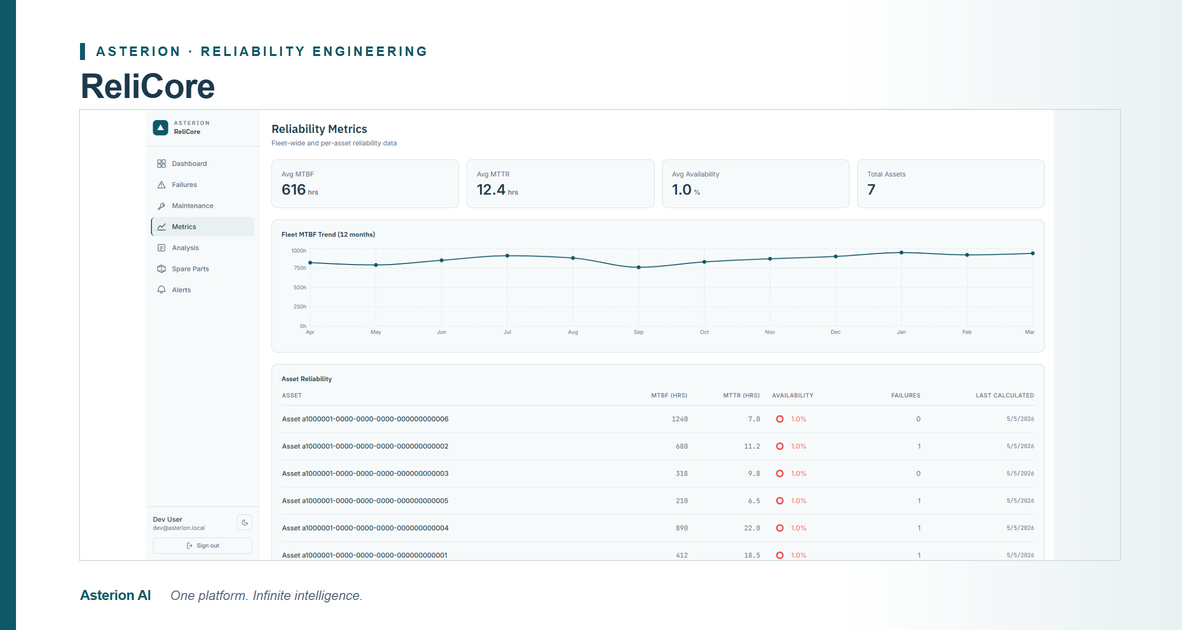
Predictive maintenance and failure analytics, built on the maintenance history you already have.
Download the product overview (PDF)
The repair bill is rarely the worst of it. Production stops, people are exposed to risk, and a regulator may want an explanation. Most reliability work is still reactive, and that's not because nobody cares. Without a way to predict failure or rank assets by consequence, there's nothing to prioritise against, so effort goes wherever the noise is loudest and risk accumulates quietly somewhere else.
Every failure logged and categorised in one structure. Unglamorous, but it's the history everything downstream depends on.
Guided RCA that turns an event into a verified causal chain. The system drafts a suggested root cause and a 5-whys from the failure record, and an engineer confirms or rejects it.
Configurable FMEA with RPN computed for you: Severity × Occurrence × Detection. Occurrence comes pre-filled from the asset's own failure history rather than from somebody's estimate.
Mean time between failures modelled with Weibull analysis and lifecycle degradation curves.
The alerting actually fires. Degradation trends are fitted over metric history and checked against remaining-useful-life thresholds, and every alert arrives with the evidence that raised it.
Reliability-centred maintenance analysis that lines maintenance plans up with asset criticality and the consequence of failure.
Evaluation Criteria for RCM Processes
Guide to the RCM Standard
Reliability & Maintenance Data Collection
Dependability Management
Risk-Based Inspection
Risk-Based Inspection Methodology
Asset criticality and lifecycle data feed reliability scoring and failure mode modelling, so predictions are grounded in the register rather than in a separate list of equipment nobody maintains.
Failure predictions and maintenance priorities inform shutdown scope, which is how a turnaround ends up addressing the assets most likely to fail rather than the ones easiest to reach.
Inspection findings and defect records update the failure mode libraries automatically, so the models stay current without anyone re-keying them.
Own the failure mode libraries, run the models, and review what RCM analysis recommends.
Schedule work and allocate people against predicted failures and asset criticality instead of a fixed calendar.
Watch availability and get early warning on the failure scenarios that would hurt most.
Track reliability over the long run and use it to argue for replacement or capital spend.
Engagements begin with an assessment of what you already have: failure history, current maintenance strategies, and how critical each asset actually is. That gives a baseline to measure against, and it usually surfaces a few things nobody expected.
Predict the failure. Prevent the loss.
Asset types and operating context differ enough that a generic diagnostic tells you very little.
Your highest-risk failure modes and the gaps in current maintenance, stated plainly.
What happens from day one, with the sequence agreed before anyone starts.
 RELICORE · RELIABILITY ENGINEERING